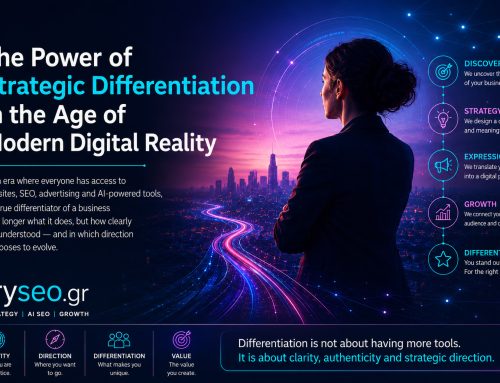
Introduction — Perception Is No Longer Only Human
A brand is not only what it says or shows. It is what is understood.
Until recently, this understanding was shaped primarily through human perception—through experiences, emotions, visuals, and narratives.
Today, something is changing.
The perception of a brand no longer belongs only to the people who encounter it, but also to the systems that interpret it before it reaches them. Systems that do not “see” in a human way, but process, connect, and reproduce information.
Artificial intelligence is not only changing how a brand appears.
It is changing how its meaning takes form—and ultimately how it reaches those who are looking for it.
This creates a new reality, where digital presence is no longer just a matter of communication, but a matter of understanding.
From SEO to AI Understanding
For years, the conversation around SEO focused mainly on visibility.
Keywords, rankings, traffic—all centered around how a brand appears in front of a user.
This approach made sense in an environment where information was displayed, but not deeply interpreted.
With the rise of artificial intelligence, this logic begins to shift.
Today, a brand doesn’t just need to appear. It needs to be structured in a way that can be understood—not only by people, but also by the systems that act as intermediaries between the brand and its audience.
This is not simply a technical evolution of SEO.
It is a deeper shift: from “how do I appear” to “how am I understood.”
How AI “Reads” a Brand
Artificial intelligence does not perceive brands the way humans do. It does not see design, feel storytelling, or respond to aesthetic coherence in the same way.
Instead of “seeing” a brand, it attempts to understand it through what exists around it.
It connects concepts, identifies patterns, and extracts meaning from the overall presence of a brand—its content, structure, consistency, and references.
What it seeks is not just information, but semantic coherence—the way individual elements connect and form a unified meaning.
In a way, it does not interpret a brand based on what it claims to be, but on what emerges from its overall presence.
And that is the essential difference.
For a human, a brand may be an experience, a feeling, or an image.
For artificial intelligence, it is a set of signals that form an interpretation.
This means that a brand’s image is no longer shaped only by how it presents itself, but also by how it is “read” within a broader digital environment.
The Gap: Human Perception vs AI Understanding
At this point, a meaningful gap begins to emerge.
A brand may be clear and strong in the minds of people—having identity, voice, and consistent communication.
At the same time, it may be unclear to the systems trying to interpret it.
This happens when its digital presence lacks structural and semantic coherence—when its elements are disconnected, or when information about it is fragmented.
For example, a brand may have a strong narrative and consistent human-facing identity, but appear differently at the data level: with inconsistent descriptions across platforms, unclear information structure, or conflicting signals.
In such cases, the interpretation created by AI does not align with the experience perceived by the human.
Artificial intelligence forms its own version—often incomplete or distorted.
And that version increasingly shapes how the brand is presented to the world.
The New Layer: AI Perception
At this point, we are no longer talking only about tools or technology.
We are talking about a new layer of perception.
Artificial intelligence acts as an intermediary: it processes, organizes, and ultimately delivers information.
It does not simply display content. It interprets and narrates it.
And this narration is not neutral.
It is shaped by how the brand exists across the digital environment: the clarity of its identity, the consistency of its messaging, and the structure of its information.
If you want to see how this shift functions as a system:
This article serves as an introduction to a broader framework of thinking about how artificial intelligence interprets brands and shapes their presence.
The full framework is presented in the book:
When AI Starts Interpreting Who You Are →
As a result, the user experience no longer begins with the brand itself—but with how AI has already understood it.
A Real Example from a Personal Brand
To better understand this shift, it is worth looking at a real example.
Over the past year, while working on my personal brand and TrySEO, I began to realize that the goal was not only presence or visibility. It was understanding.
At one point in this process, I realized that I was trying to express too many different things at once. This created noise—not necessarily for people, but for the systems trying to understand what this brand actually is.
Initially, the digital presence existed, but not as a unified structure with a clear meaning.
Gradually, the focus shifted from “what is presented” to “how what is presented connects.”
In practice, this process feels like the gradual removal of noise: disconnected information, inconsistent messaging, content without clear direction.
As the noise decreases, the signal becomes clearer—and easier for a system built on patterns and connections to understand.
And then something new begins to emerge.
Artificial intelligence can now position the brand. Describe it. Place it within a broader context.
Not because something entirely new was created—but because what already existed became understandable.
The Bridge Between Perception and Psychology
This shift is not only digital.
It reflects a broader change in how perception itself is formed.
Today, the information that reaches a person has already been interpreted.
In many cases, artificial intelligence forms the first layer of truth for the user—the first interpretation they receive before directly encountering the brand.
This does not mean that this interpretation is always accurate. But it is the one that shapes the initial framework through which the user will perceive everything that follows.
If that interpretation is unclear or distorted, then the experience that follows begins from a different starting point.
And this is where a new bridge is formed:
Between human understanding and the systems that shape it.
From Wikipedia to the AI Layer
For years, understanding information online relied on fixed reference points, such as Wikipedia.
Today, artificial intelligence does not rely on a single source. It synthesizes information from multiple points, seeking consistency and meaning across the whole.
Wikipedia does not lose its value.
But it is no longer the single point of understanding.
Trust shifts from a single source to the overall consistency of a brand’s presence.
What once functioned as a stable reference point is now part of a dynamic system of relationships.
The New Question for Brands
The question is no longer only how a brand appears.
It is:
How is it understood?
How is it positioned?
How is it described?
And perhaps, more deeply:
What is the imprint of its essence when it is translated through a system that does not “see” it—but interprets it?
Closing — From Communication to Understanding
Digital presence is no longer only communication.
It is a structure of understanding.
And within this new reality, the challenge is not to say more.
It is to become something that can be understood—consistently and clearly.
This shift from communication to understanding
is not merely a trend.
It reflects a new framework within which brands begin to take position.
To explore how this operates as a system, the framework is developed in my book:
When AI Starts Interpreting Who You Are.
Perhaps, in the end, the question is not only how a brand will be understood by artificial intelligence, but what this will mean for its very nature.
Will this shift lead to greater authenticity and consistency?
Or to a more mechanical approach, where brands follow rules without staying connected to their purpose?