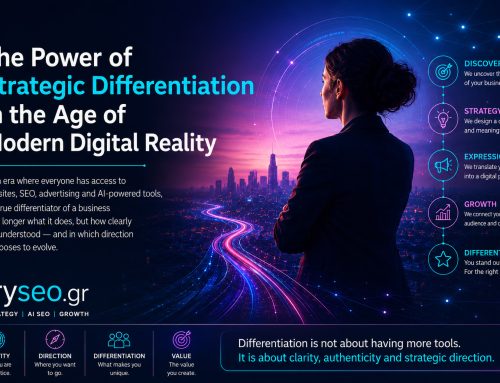
What available data suggests about the rise of AI assistants — and what this may mean for SEO, traffic, and digital visibility.
In recent years, artificial intelligence tools such as ChatGPT, Perplexity, and the AI capabilities now increasingly integrated into search engines have begun to change the way many people interact with information online.
This naturally leads to an important question:
Are people beginning to use traditional Google Search less?
This question matters — not because we are looking for a “winner” between Google and AI systems, but because it reflects a deeper shift:
how people choose to seek understanding.
For years, the journey was relatively straightforward.
A user entered a search query, the search engine returned a list of results, and the user explored different sources until forming their own understanding.
Today, in many cases, that experience looks different.
A user may now ask a more complex question and receive an already synthesized answer, comparison, or summary — before ever visiting a website.
This does not automatically mean that Google is “losing” or that search is being replaced.
But it does make it reasonable to ask whether search behavior is changing — and what that could mean for:
- businesses that rely on online discovery,
- websites that invest in organic visibility,
- and SEO professionals who have spent years helping brands become discoverable.
In this article, we will not assume conclusions.
We will examine what the available data suggests, what cannot yet be stated with certainty, and what deeper transition may be emerging within the digital ecosystem.
Because the more meaningful question may not simply be:
“Are fewer searches happening on Google?”
But rather:
“How is the way people search for, evaluate, and understand information online changing?”
What the Available Data Actually Shows
Before drawing conclusions about whether Google Search is being used less because of AI assistants, it is important to clarify something:
not all data is of the same nature.
There is a meaningful difference between:
- official platform-reported data,
- third-party analyses based on clickstream datasets,
- academic research,
- and market forecasts about future behavior.
Clear understanding begins with making this distinction.
AI assistant usage is growing significantly
There is little doubt that generative AI tools have experienced remarkably rapid adoption.
According to Similarweb analyses of the AI ecosystem, platforms such as ChatGPT, Gemini, Claude, and Perplexity have shown substantial increases in traffic and usage within a relatively short period of time.
(Source: Similarweb AI Market Reports — ( https://www.similarweb.com/blog/marketing/geo/gen-ai-stats/ & https://www.similarweb.com/blog/insights/marketing-insights/gen-ai-market-winners/ ))
This clearly suggests that more people are choosing to interact with conversational AI systems for information, comparisons, and answers.
However, this alone does not prove that Google Search usage is declining at the same rate.
Because part of this behavior may be replacing:
- forum browsing,
- direct website visits,
- customer support searches,
- educational exploration,
- or entirely new usage patterns that did not previously exist.
Google remains an exceptionally strong search ecosystem
Despite the growth of AI tools, Google continues to handle an enormous volume of global search activity.
This matters because public conversations can sometimes create the impression of immediate disruption or replacement, without publicly available data clearly supporting such an absolute conclusion.
Put simply:
the rise of AI does not automatically mean the collapse of traditional search behavior.
What appears more likely is a gradual diversification in how people choose to search for different types of information.
Where the clearest shift appears: click behavior
One of the most important observations may not be the total number of searches.
It may be what happens after the search.
Academic research around AI-generated search summaries (such as Google AI Overviews) has already suggested that synthesized answers can reduce the user’s need to visit the original source.
For example, one study observed traffic reductions to Wikipedia when AI-generated summaries appeared in search experiences.
(Source: arXiv study on AI Overviews & traffic impact — ( https://arxiv.org/html/2602.18455 ))
This is an important distinction:
fewer clicks do not necessarily mean fewer searches.
But they do indicate a changing discovery journey.
Market forecasts should be interpreted carefully
Various forecasts have circulated, including Gartner’s widely discussed prediction that traditional search traffic could decline significantly due to AI assistants by 2026.
(Source: Gartner forecast — ( https://searchengineland.com/search-engine-traffic-2026-prediction-437650 ))
Clarity matters here:
This is a forecast, not a recorded fact.
Forecasts can be useful as strategic signals.
But they should not be presented as already-proven reality.
What we can say with reasonable confidence today
Based on currently available information, a more balanced conclusion would be:
✔ Conversational AI usage is increasing.
✔ Information-seeking behavior is evolving.
✔ AI-generated answers are affecting click behavior.
✔ Google remains an exceptionally dominant player.
✔ There is not yet enough public evidence to support an absolute “Google decline because of ChatGPT” narrative.
This does not mean that “nothing is changing.”
It means we need to look more carefully at what is actually changing beneath the surface.
The Real Shift May Be Behavioral, Not Merely Numerical
Even if tomorrow we had precise data showing that total Google searches had not declined dramatically, that alone would still not answer the more meaningful question.
Because the most important shift may not be about the absolute number of searches.
It may be about how people now expect to receive answers.
For many years, online search was fundamentally a process of exploration.
A user would:
- perform a search,
- review different results,
- open multiple sources,
- compare information,
- and gradually form their own understanding.
The search engine primarily functioned as an information retrieval system.
It presented options.
The final interpretation remained largely in human hands.
Today, in many situations, that relationship is changing.
A user can now ask:
“Which CRM would be the best fit for a small boutique hotel in Greece? Compare options based on cost, integrations, and ease of use.”
Instead of simply receiving links, they may receive:
- a comparison,
- a synthesized summary,
- a recommendation framework,
- or an already-structured initial direction.
The same applies across many contexts:
- “What is the best way to plan ERP integration for WooCommerce?”
- “What should I consider before starting SEO for a medical practice?”
- “What are the key differences between these two investment options?”
The difference here is not merely technological.
It is cognitive.
People are gradually moving from a model where they collect pieces of information toward a model where they first request synthesis and interpretation.
This does not mean human judgment disappears.
Nor does it mean websites lose their relevance.
But it does mean that the first point of contact with information may increasingly be a system that does not simply present sources, but actively constructs an initial layer of understanding.
And that fundamentally changes the digital discovery journey.
Because when the way people seek understanding changes, the meaning of “visibility” changes as well.
From Information Retrieval to Interpretation
To understand what is truly changing, it may help to distinguish between two different ways a system can assist a person in finding information.
The first is information retrieval.
The second is information interpretation and synthesis.
For many years, search engines primarily operated at the first level.
A user entered a query, and the system returned relevant sources.
That model looked roughly like this:
User → Search Engine → Search Results → Website Exploration → Human Interpretation
The system supported discovery.
But interpretation remained largely in human hands.
Today, with conversational AI systems and AI-generated search experiences, a second model is increasingly emerging:
User → AI System → Interpretation / Synthesis → Selective Source Exposure → Human Decision
In this environment, the system is no longer functioning only as a guide toward information.
It is actively participating in shaping the first layer of understanding.
This is a meaningful shift.
Not because human beings lose the ability to think.
But because the initial framing of information may now already be shaped before the user visits any source at all.
And this creates new questions:
- Which brands appear within that interpretive process?
- Which ones are ignored?
- Which ones are represented accurately?
- Which ones are interpreted through vague, fragmented, or contradictory signals?
At this point, the concept of “visibility” begins to take on expanded meaning.
For years, visibility largely meant:
“Appearing in search results.”
Today, in certain digital contexts, visibility may increasingly mean something more:
being understandable as an entity within a system that synthesizes, compares, and interprets information.
This does not replace SEO.
But it expands the framework through which SEO may need to be understood.
Because when systems are no longer limited to retrieval, but increasingly participate in synthesis, the question becomes not only:
“How easily can someone find me?”
But also:
“What does the system understand about me before the human ever visits?”
TrySEO Perspective
At TrySEO, we see this transition not as a replacement of traditional search, but as an expansion of the digital ecosystem.
SEO still fundamentally matters for discoverability.
But in an AI-mediated discovery environment, it increasingly also involves interpretability.
This Is Not Merely a Technological Shift
When we talk about AI systems that summarize, compare, and present information before a user ever visits a source, it can be tempting to view this simply as another technological feature.
But what may be happening is deeper.
For many years, the primary challenge for businesses was discoverability.
To appear when someone searched for something relevant.
That remains important.
But in an environment where systems are no longer limited to retrieving information, an additional layer emerges:
how a system forms understanding about an entity.
For example:
Two businesses may offer similar services.
Both may have websites.
Both may publish content.
Both may have some level of SEO presence.
And yet, they may not be equally positioned within an interpretive environment.
If one brand communicates:
- clear positioning,
- consistent service descriptions,
- a coherent identity,
- trustworthy signals across sources,
while the other presents:
- contradictory messaging,
- ambiguity,
- fragmented entity clarity,
then the two are not equivalent from the perspective of a system attempting to form understanding.
Not because one “has better keywords.”
But because the system may be able to construct a more coherent understanding of one than the other.
This is one of the deeper questions explored in the book:
When AI Starts Interpreting Who You Are
The question is not only how a brand becomes visible.
It is how a brand becomes understandable, comparable, and ultimately selectable within an AI-mediated ecosystem.
The transition we are observing in online search is therefore not merely an interface shift.
It is not simply about whether people use Google queries or AI prompts.
It concerns something more fundamental:
who participates in shaping the first layer of understanding about a business, a person, or a service.
And that changes how digital presence needs to be approached.
What This Means Practically for Businesses
Regardless of whether total Google searches decline rapidly, slowly, or remain strong, one thing is becoming increasingly clear:
the way people discover and evaluate businesses online is evolving.
And that evolution has practical implications.
1. Organic traffic is no longer the only indicator of digital visibility
For many years, businesses often evaluated their online presence primarily through metrics such as:
- rankings,
- impressions,
- clicks,
- sessions,
- leads generated from organic traffic.
These metrics still matter.
But in an environment where users may receive an initial summary, comparison, or recommendation before ever visiting a website, those metrics do not always tell the full story.
A business may:
- still be part of the available information ecosystem,
- still influence decision-making,
- yet not receive the same click behavior as before.
This does not automatically mean a loss of value.
But it does suggest that visibility measurement requires a more mature interpretation.
2. A brand’s first impression may form before a website visit
Previously, a company’s website was often the first substantial point of contact.
Today, in many cases, users may form an initial impression through:
- AI-generated summaries,
- comparison responses,
- conversational recommendations,
- synthesized overviews.
This means that brand narrative is no longer shaped exclusively within the website itself.
It may begin earlier.
And if a brand’s digital footprint is unclear, inconsistent, or incomplete, that first impression may be equally weak or inaccurate.
3. Clarity becomes a strategic advantage
In an environment where systems attempt to synthesize information, clarity is no longer simply a branding preference.
It becomes an issue of understanding.
A business that consistently communicates:
- what it offers,
- who it serves,
- how it differentiates itself,
- what its identity truly is,
makes interpretation easier not only for humans —
but also for systems attempting to construct understanding.
4. Presence across multiple touchpoints requires coherence
A “good website” alone is no longer always enough.
Systems may draw signals from multiple places, including:
- website content,
- business listings,
- author profiles,
- external mentions,
- structured data,
- content consistency across platforms,
- linked references.
When these signals fail to align logically, ambiguity emerges.
And ambiguity rarely helps understanding.
5. The discovery journey is becoming more complex
A potential customer may now:
- perform a Google search,
- ask ChatGPT,
- encounter an AI-generated overview,
- compare multiple sources,
- visit reviews,
- and only then return to the website.
The journey is no longer linear.
Which means digital strategy increasingly needs to treat online presence as an ecosystem — not merely as an isolated SEO channel.
What this does not mean
It is equally important to be clear about what this does not mean.
It does not mean that:
- SEO is “dead,”
- websites have lost their importance,
- or every business must immediately rebuild everything.
But it does suggest that businesses that understand this transition early may have greater clarity in how they design their digital presence moving forward.
What This Means for SEO Professionals
If the way people discover information online is evolving, it is only natural that the way we understand SEO may need to evolve as well.
For many years, SEO helped businesses become discoverable.
To appear when users searched for:
- products,
- services,
- information,
- solutions to specific needs.
And this was never merely a technical exercise.
Behind every strong SEO strategy, there was already something deeper:
- intent understanding,
- content clarity,
- information architecture,
- relevance,
- signal consistency.
In other words:
SEO has always influenced how digital systems understand a page, a topic, or an entity.
What is changing today is not the essence of that work.
It is the environment in which that work operates.
In a retrieval-first environment, the primary objective was:
to be found.
In an environment where systems increasingly:
- synthesize,
- compare,
- summarize,
- and participate in shaping the first layer of understanding,
an additional strategic layer emerges:
to be understood clearly.
This does not mean every SEO professional must suddenly abandon existing practices.
But it does suggest that the role of SEO may expand.
From:
visibility optimization
toward:
visibility + interpretability alignment
Why this matters
SEO professionals occupy a uniquely important position.
For years, they have worked with many of the signals that shape digital discoverability:
- information architecture,
- structured content,
- topical relevance,
- internal linking,
- authority signals,
- content clarity.
In an AI-mediated ecosystem, many of these same elements become even more strategically significant.
Not only because they support rankings.
But because they support understanding.
Perhaps the real question is not “AI SEO vs traditional SEO”
But rather:
What does SEO mean when digital systems are no longer limited to information retrieval?
For us, the answer is not the replacement of traditional SEO.
It is the expansion of its framework.
SEO remains critically important.
But in certain contexts, it may increasingly need to be understood not only as a discovery mechanism —
but as part of a broader interpretability ecosystem.
Why we use the term AI SEO at TrySEO
At TrySEO, we use the term AI SEO not as a trend label.
Nor as a superficial rebranding of existing SEO.
But as an attempt to describe a real strategic evolution:
that in an environment where AI systems increasingly participate in mediating information, clarity, coherence, and interpretability acquire growing strategic importance.
What Practically Needs to Change in a Brand’s Digital Presence
If we accept that online information discovery is evolving from a purely retrieval-driven model toward an environment where interpretation and synthesis play a growing role, a practical question naturally emerges:
How should a digital presence be designed so that it is not only discoverable — but also understandable?
There is no universal formula.
But there are several principles that become increasingly strategic.
1. Identity clarity
One of the most common problems we encounter is ambiguity.
A business may offer valuable services, yet its online presence still leaves important questions unanswered:
- What exactly does it do?
- Who does it serve?
- How does it differentiate itself?
- What is its true specialization?
For a human, this creates confusion.
For a system attempting to synthesize understanding, it creates weak interpretive signals.
2. Coherence across digital touchpoints
Information about a brand does not live only within its website.
It often exists across:
- business directories,
- author profiles,
- social references,
- guest publications,
- partner mentions,
- media appearances,
- structured data outputs.
When these elements fail to align, the result is not simply branding inconsistency.
It becomes fragmented understanding.
3. Structured information that supports understanding
Structure is not only about SEO crawling.
It is also about semantic clarity.
For example:
- clearly defined services,
- sound information architecture,
- consistent entity descriptions,
- author attribution,
- schema markup where appropriate,
- logical internal relationships.
All of these help systems understand context — not merely keywords.
4. Content that explains, not merely targets
In a more mature digital ecosystem, content does not function only as a vehicle for rankings.
It becomes an expression of understanding.
The question is no longer only:
“Which keyword are we targeting?”
But also:
“Does this content help a human — or a system — accurately understand who we are and what we offer?”
5. Relationships between entities matter
As systems increasingly move toward entity-based understanding, the relationships between entities become strategically important.
This includes relationships between:
- people,
- brands,
- services,
- publications,
- projects,
- collaborations.
This is not simply about links.
It is about coherent contextual relationships.
6. Strategic consistency instead of tactical fragmentation
A common problem in many digital presences is fragmentation.
A website may have been created in one era.
Social messaging may follow a completely different logic.
Articles may exist without strategic coherence.
Profiles may communicate inconsistent identities.
In an interpretive environment, this fragmentation becomes more visible.
Consistency becomes a strategic asset.
This is not only about technology
It is important to be clear:
This is not primarily about AI tools.
Nor is it about “smarter tactics.”
It is about clarity of meaning.
Because as systems become more complex, human clarity becomes even more valuable.
Perhaps the Real Question Is Not Whether Searches Are Declining
When we began this article, the initial question was simple:
Are Google searches declining because more people are using AI assistants?
The honest answer is:
the available data suggests change, but not enough evidence for simplistic conclusions.
Conversational AI usage is growing.
Discovery journeys are evolving.
Click behaviors are being affected.
And yet, Google remains an exceptionally powerful part of the digital ecosystem.
So perhaps the most useful conclusion is not an early prediction about “who will win.”
Perhaps it is something deeper.
That the way people search for information, form initial understanding, and evaluate options online is evolving.
And when that changes, the framework through which businesses, brands, and professionals design their digital presence changes as well.
The question then becomes not only:
“Do I appear in search results?”
But also:
“How is my presence understood within an ecosystem where systems increasingly participate in shaping information?”
For some businesses, this may require only small adjustments.
For others, it may call for a more strategic redesign of how they communicate online.
There is no reason for panic.
But there is a strong reason for clarity.
Because every technological transition creates noise.
But behind the noise, there is usually a more meaningful question:
what is truly changing in the way understanding is formed?
If you are wondering how your business is presented, connected, and interpreted within today’s digital ecosystem, then AI SEO is not merely a theoretical discussion.
It is a strategic exploration of clarity, coherence, and how your brand is understood online.
→ Explore our approach to AI SEO at TrySEO
For those who would like to explore the conceptual framework behind this transition more deeply: