Introducing the AI Coherence Framework
SEO was built for visibility
For years, SEO has focused on a clear and practical objective: helping information become visible.
Websites were optimized so search engines could discover, index, and retrieve relevant pages when users searched for specific topics, products, or services. Rankings mattered because visibility created opportunity. If a business appeared in the right search results, it could be discovered.
And this logic still matters.
Visibility remains an essential part of digital presence.
But something important has changed.
Search systems are no longer operating only as retrieval mechanisms. Increasingly, AI-driven systems do more than identify relevant documents. They compare signals, connect references, identify patterns, and generate responses based on interpreted meaning.
This introduces a new layer of strategic importance.
Because being visible is not the same as being understood.
Retrieval and interpretation are not the same thing
Traditional search engines were primarily designed to retrieve relevant information.
A user entered a query.
The system matched signals.
Relevant pages appeared.
Generative AI systems increasingly operate differently.
Instead of simply returning documents, they increasingly interpret information across multiple sources and contexts. They do not rely only on what a single page says. They compare descriptions, references, entity signals, structured information, repeated patterns, and contextual relationships.
This creates a meaningful distinction:
A system can retrieve your content without forming a stable understanding of who you are.
And this is where many businesses — and even many SEO strategies — begin to encounter a blind spot.
Because discoverability alone does not guarantee interpretability.
SEO now operates across two dimensions
For a long time, visibility was enough to explain the purpose of SEO.
Today, visibility remains important — but it no longer explains the whole picture.
SEO increasingly operates across two connected dimensions:
- Visibility
Helping systems discover your presence. - Interpretation
Helping systems form a coherent understanding of what that presence represents.
Visibility creates discoverability.
Coherence enables interpretation.
Interpretation shapes position.
This shift matters because AI-generated responses are not simply assembled from isolated pieces of information. They emerge from patterns that appear stable enough to be interpreted, reused, and selected.
Which raises an important question:
If visibility alone does not create understanding, what does?
The problem with fragmented visibility
Many businesses assume that more digital presence automatically leads to stronger recognition.
More content.
More pages.
More mentions.
More activity.
But repetition alone does not necessarily create clarity.
In many cases, it creates noise.
A business may have:
- a website describing one positioning,
- social profiles using different language,
- directory listings with incomplete information,
- interviews or guest content that describe expertise differently,
- inconsistent entity definitions across platforms,
- fragmented authority signals that never fully connect.
From a human perspective, this may already feel confusing.
From a machine interpretation perspective, the problem becomes even larger.
Because AI systems do not simply count presence.
They attempt to interpret patterns.
And fragmented patterns rarely create stable understanding.
Introducing the AI Coherence Framework
To better explain this transition from visibility to understanding, I developed the AI Coherence Framework.
The framework describes how fragmented digital visibility can evolve into stable AI recognition through signal alignment, interpretive consistency, and repeated selection.
It is not a model about generating more content.
It is a model about how meaning becomes stable enough for systems to recognize, reuse, and reference.
At its core, the framework explores a simple but increasingly important question:
What creates stable recognition in environments where AI interprets information rather than simply retrieving it?
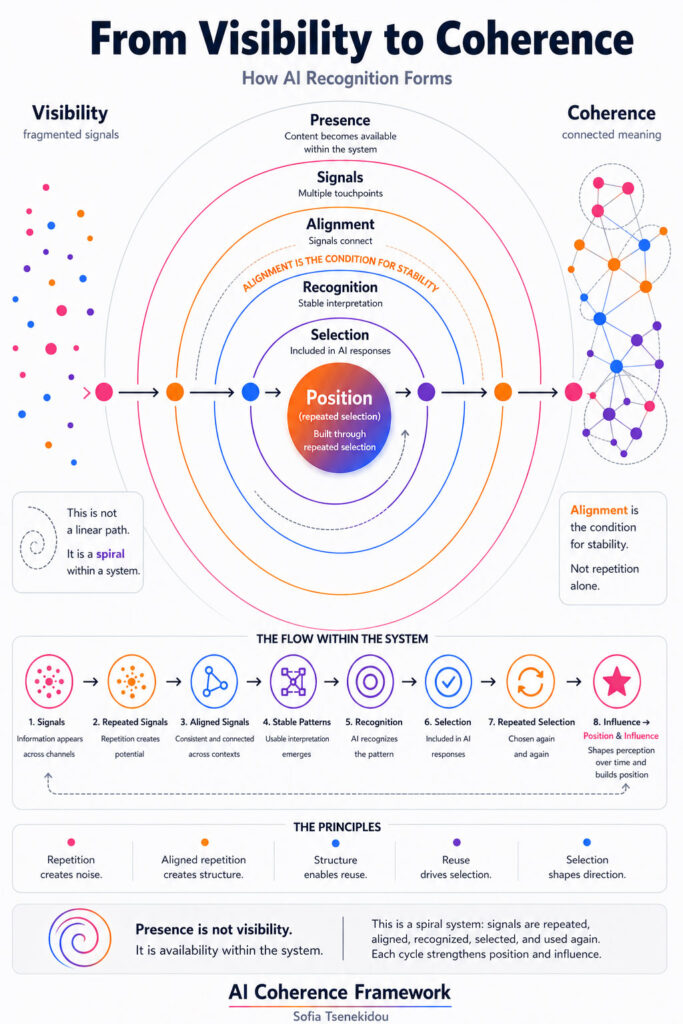
The visual below summarizes the AI Coherence Framework and illustrates how fragmented digital visibility can evolve into stable AI recognition through repeated interpretation and selection.
AI Coherence Framework — Sofia Tsenekidou / TRYSEO.GR
Understanding the AI Coherence Framework
The AI Coherence Framework describes how digital presence evolves from fragmented visibility into stable recognition.
This is not a purely linear process.
It behaves more like a spiral process, where signals are repeated, connected, interpreted, selected, and reinforced over time.
Each cycle can strengthen recognition.
Each inconsistency can weaken it.
The difference lies in coherence.
Let’s break the framework down.
1. Visibility — The starting point of discoverability
Visibility is where most digital strategies begin.
It refers to the presence of information across searchable or accessible environments.
A website page.
A business profile.
A directory listing.
A guest article.
A social media account.
A structured data entry.
These signals create discoverability.
But visibility alone does not guarantee clarity.
At this stage, information may still exist as fragmented signals rather than as connected meaning.
A system may detect presence without yet understanding what that presence consistently represents.
Visibility creates opportunity.
It does not create interpretation.
2. Presence — Becoming available inside the system
Presence is often confused with visibility, but they are not identical.
Visibility refers to being discoverable.
Presence refers to becoming available within the interpretive environment of the system.
This distinction matters.
A page may rank in search results and still contribute very little to stable AI understanding.
Why?
Because availability alone does not equal meaningful connection.
Presence simply means the information exists within the system’s accessible environment.
Interpretation requires more.
As the framework states:
Presence is not visibility. It is availability within the system.
3. Signals — The distributed touchpoints of meaning
AI systems rarely form understanding from a single source.
Instead, interpretation emerges from multiple signals distributed across environments.
These signals may include:
- website content
- structured data
- author profiles
- business listings
- interviews
- citations
- guest articles
- social platforms
- knowledge graph references
- recurring descriptions of expertise or identity
Each signal contributes potential meaning.
But isolated signals remain incomplete.
A single strong statement does not automatically create stable recognition.
Because interpretation depends not only on what is said, but on how meaning appears across connected contexts.
4. Alignment — The condition for stability
This is one of the most important layers of the framework.
Signals alone do not create coherence.
Alignment does.
Alignment means that signals support a stable interpretation rather than contradicting one another.
This does not mean identical wording everywhere.
It means semantic consistency.
For example:
A consultant may describe herself as:
- “SEO strategist” on her website,
- “growth consultant” on LinkedIn,
- “AI marketing advisor” in guest articles,
- and “web developer” in business directories.
Each description may be individually true.
A human reader may eventually reconcile these differences with enough context. AI systems, however, interpret only the signals available to them. Without a stable interpretive center, recognition becomes less certain.
Not because the information is false.
But because the system struggles to identify a reusable core pattern.
If those same signals consistently reinforce a clearer strategic identity, interpretive stability becomes significantly stronger.
This is why:
Repetition alone increases exposure. Alignment increases interpretability.
Or more simply:
Alignment is the condition for stability.
Without alignment, repeated visibility often becomes noise.
5. Recognition — When interpretation becomes reusable
Recognition begins when the system can identify a sufficiently stable interpretive pattern.
At this stage, the information is no longer treated as disconnected fragments.
A coherent interpretation begins to emerge.
This does not mean perfect certainty.
It means the system detects enough consistency to reuse the pattern as a working understanding.
Recognition is a critical transition point.
Because before recognition, signals remain informational fragments.
After recognition, they begin functioning as interpretable identity.
6. Selection — The moment interpretation becomes visible in AI outputs
Recognition alone does not guarantee selection.
A system may identify a stable pattern and still choose not to use it.
Selection happens when interpreted meaning is considered sufficiently relevant, useful, stable, or contextually appropriate for response generation.
This is where the shift becomes highly practical.
Because selection determines what appears in AI-generated environments.
This may include:
- summaries
- recommendations
- entity references
- explanatory responses
- comparative answers
- contextual suggestions
Selection is where interpretation becomes externally visible.
And repeated selection becomes even more important.
7. Position — How repeated selection shapes perceived authority
Position is not something an entity declares.
It is something systems gradually form through repeated selection.
Position is not directly engineered in the same way visibility can be.
It emerges through repeated interpretive confidence.
A useful analogy is trust.
Trust is rarely created in a single interaction.
It forms when consistency leads to repeated confidence over time.
Position behaves similarly.
When systems repeatedly select an entity across contexts, interpretive trust strengthens.
When a business, professional, concept, or brand is selected consistently across contexts, that repeated inclusion begins shaping perceived relevance, authority, and interpretive stability.
This is why position is not merely about ranking.
It is about interpretive persistence.
As the framework suggests:
Position is built through repeated selection.
And repeated selection influences how future interpretation unfolds.
This creates a reinforcing loop.
Stable interpretation supports selection.
Selection reinforces position.
Position influences future interpretive confidence.
This is why the framework behaves as a spiral rather than a one-time sequence.
Why this changes the role of SEO professionals
For many years, SEO professionals focused primarily on discoverability.
Their role was to help businesses become visible within retrieval systems.
This involved improving structure, relevance, accessibility, content organization, indexing clarity, keyword alignment, and technical performance — all essential components of digital visibility.
And these foundations still matter.
But if AI systems increasingly form understanding through interpretation rather than retrieval alone, then the implications become much broader.
Because SEO professionals have never worked only with traffic.
They have always worked with signals.
What changes now is the significance of those signals.
Signals are no longer contributing only to discoverability.
They increasingly contribute to interpretation.
This changes the strategic role of SEO.
The question is no longer only:
How do we help systems find this information?
A new question emerges:
What understanding do these signals create when systems compare them?
This is a fundamentally different level of responsibility.
Because interpretation affects:
- how businesses are described,
- how expertise is perceived,
- how authority is inferred,
- how relevance is established,
- and ultimately, how entities may be selected or excluded from AI-generated environments.
This does not mean SEO becomes something entirely new.
It means the role expands.
Visibility remains essential.
But visibility alone is no longer enough to explain how digital recognition forms.
Practical implications for businesses
For businesses, this shift introduces an important reality.
Digital presence can no longer be evaluated only by asking:
- Are we ranking?
- Are we visible?
- Are we publishing enough?
A more useful question may be:
If AI systems compare our signals, what stable interpretation would they form?
This often reveals strategic blind spots.
For example:
A business may have:
- strong rankings but weak entity clarity,
- multiple service descriptions that conflict,
- disconnected founder and brand positioning,
- incomplete structured data,
- inconsistent authorship signals,
- fragmented mentions across platforms,
- no coherent relationship between expertise, services, and identity.
From a traditional SEO perspective, some of these issues may appear secondary.
From an interpretive perspective, they become highly relevant.
Because interpretability depends on coherence.
This does not require perfection.
But it does require intentional signal architecture.
The broader shift
SEO is not disappearing.
But the environment in which SEO operates is evolving.
Search helped systems retrieve information.
AI increasingly participates in interpretation.
And interpretation changes how recognition forms.
This is not only a technical shift.
It is a structural one.
Because once systems begin forming reusable understanding, digital presence becomes more than visibility management.
It becomes meaning architecture.
Visibility may create discoverability.
But coherence shapes understanding.
Closing reflection
The AI Coherence Framework was developed to help make this shift visible.
Not as a replacement for traditional SEO.
But as a way of understanding the emerging interpretive layer that increasingly shapes digital recognition.
As AI systems continue to compare, connect, and reuse information, the strategic question becomes less about isolated optimization and more about coherent representation.
Because in environments where interpretation influences selection, clarity is no longer only a communication advantage.
It becomes part of how recognition itself forms.
The AI Coherence Framework forms part of the conceptual work behind When AI Starts Interpreting Who You Are, which explores how AI-driven interpretation shapes digital identity, recognition, and strategic responsibility.
The broader conceptual work behind this book can also be explored on Sofia Tsenekidou’s official author website.