The Real Question Behind the Search
More and more business owners are beginning to ask questions like:
- How can my business appear in ChatGPT?
- Why does ChatGPT mention some businesses and not others?
- Can I do SEO to make ChatGPT mention my business?
- Why doesn’t ChatGPT recommend my business?
The question is entirely reasonable.
As more people use artificial intelligence tools to ask questions, compare options, or request recommendations, a business’s presence within these environments is starting to carry real strategic importance.
Before answering the “how,” however, an important clarification is needed.
ChatGPT does not function in the same way as traditional Google search.
It does not simply display a list of results.
It generates answers.
And that changes the nature of the online presence a business may need.
For years, the core SEO question was:
“Can my business be found?”
Today, a second question is beginning to emerge:
“Can an AI system form a sufficiently clear understanding of my business to meaningfully use it when generating an answer?”
This is the real question behind the search.
Important Clarification: There Is No Direct Control Over ChatGPT Recommendations
Before we go further, an important clarification is necessary.
Business mentions or recommendations inside AI-generated responses do not operate through a public, transparent ranking system like the one we know from Google search.
There is no official way for a business to “submit” itself to ChatGPT in order to appear in its responses.
There is also no guarantee that changing a website, schema markup, or content will directly result in visibility or recommendation by an AI system.
The approach described in this article is strategic and interpretive.
It is not based on access to or knowledge of ChatGPT’s internal mechanisms.
It is based on the observation that the more clearly, consistently, and credibly a business expresses itself online, the easier it becomes for both people and systems to form a more stable understanding of what that business represents.
In other words, we are not talking about control.
We are talking about clarity, interpretability, and the responsible management of digital presence.
Mention Is Not the Same as Recommendation
There is another important distinction that needs to be made.
A business appearing inside an AI-generated answer is not always the same thing as being recommended.
An AI system may:
- mention a business as an example
- include it in a comparison
- use it as a reference point
- generate a list of possible options
- or present it as a recommendation within a specific conversational context
These behaviors are not necessarily the same.
And we do not know that they all operate through exactly the same mechanism.
So when we refer in this article to online presence and AI visibility, we do not mean recommendation alone.
We are speaking more broadly about whether a business is sufficiently clear, recognizable, and understandable to be meaningfully included within AI-generated responses.
Not All AI Presence Works the Same Way
When a business owner wonders whether their business can appear in ChatGPT, many different AI environments often seem like the same thing:
- Google AI Overviews
- ChatGPT responses
- recommendations from tools like Perplexity
- AI-generated snippets within search experiences
But they do not all function in the same way.
And that distinction matters.
For example, a business appearing in a Google AI Overview is often related to whether website content is structured in a way that can be retrieved, understood, and used as part of a generated answer experience within search.
In those environments, elements such as:
- structured data (schema markup)
- FAQ content
- semantic HTML structure
- clear extractable answers
- topical relevance
may play an important role in the likelihood of inclusion.
Conversational AI platforms, however—where users actively interact with systems such as ChatGPT—operate within a broader interpretive context.
The question is not only:
“Is there a piece of content I can use?”
But also:
“What does this business appear to represent as a whole?”
This means a business’s digital presence is not evaluated only as isolated content.
It is also interpreted through the broader meaning that appears to emerge from its digital ecosystem.
And this is where a deeper distinction begins to appear.
We are no longer talking only about visibility.
We are talking about different layers of presence.
The 3 Layers of a Business’s AI Presence
To better understand what is changing, it helps to look at a business’s digital presence through three distinct layers.
Because the question is not simply whether a business “exists” online.
The question is at what level it exists—and in what way it may become usable.
To make this evolution even clearer—from basic online visibility to interpretive understanding within AI-driven environments—we created the explanatory framework below.
These are not three competing models.
They are three layers of the same digital presence, each building on the previous one.
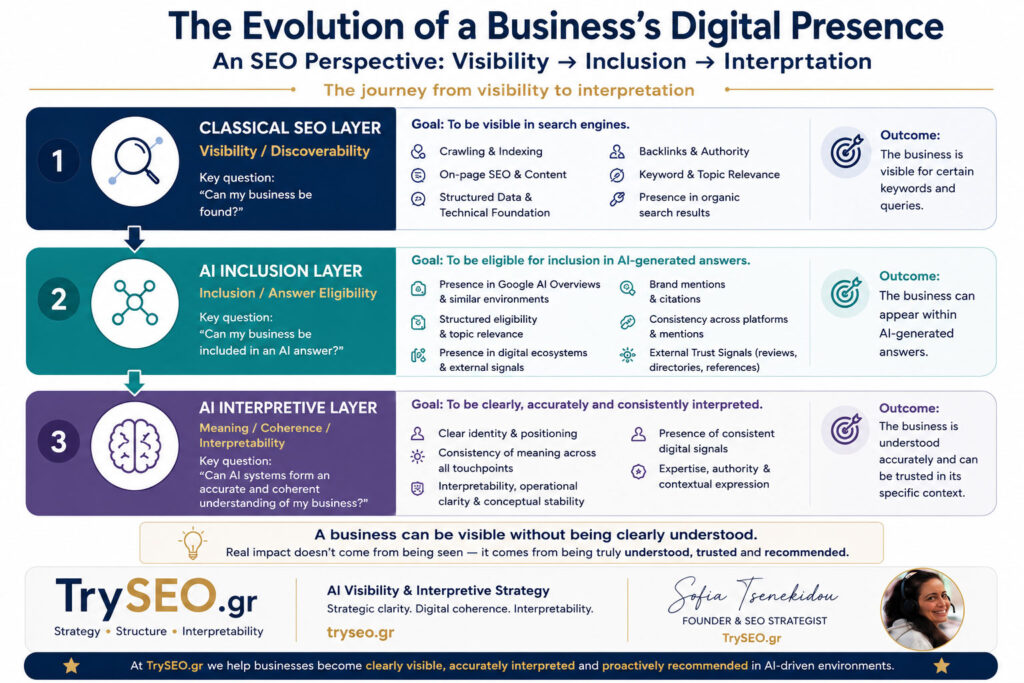
Diagram: The evolution of a business’s digital presence — from online visibility (SEO visibility), to inclusion in AI-generated responses, and ultimately to AI interpretability.
1. Classical SEO — The Visibility Layer
The first layer is the one we already know from traditional SEO.
Here, the core question is:
“Can my business be found?”
At this level, the goal is discoverability.
A business invests in:
- keyword strategy
- technical SEO
- content creation
- internal linking
- authority building
- organic search visibility
so that relevant pages can appear when someone performs a search.
This layer remains important.
Without discoverability, digital presence remains limited.
2. AI Search / Generated Answer Inclusion Layer
The second layer relates to the likelihood of a business’s content being used within AI-assisted search experiences.
Here, the question changes:
“Can my content be selected as part of an AI-generated answer?”
At this level, factors such as the following may play a role:
- structured data (schema markup)
- FAQ structures
- semantic clarity
- extractable answers
- content formatting
- entity signals
At this level, simply having content is not enough.
It needs to be usable within answer-generation environments.
3. AI Interpretive Layer
The third layer goes deeper.
It is not only about whether a piece of content can be used.
It is about whether the business itself can be interpreted with sufficient coherence.
Here, the question becomes:
“What does an AI system appear to understand that my business represents as a whole?”
At this level, the focus shifts from individual content assets to the broader consistency of the entity ecosystem.
This may include:
- website messaging
- About page identity
- service architecture
- author signals
- schema consistency
- external mentions
- topical coherence
- repeated semantic patterns
At this level, the issue is no longer only presence.
It is interpretation.
These three layers do not cancel each other out.
They coexist.
A business may be strong in the first layer and weak in the third.
Or it may have structured content that helps with generated search answers, while lacking the broader coherence needed for conversational AI systems to form a stable working understanding.
And this distinction is often where the real understanding of the subject begins.
Why Online Visibility Does Not Always Translate into AI Inclusion
At this point, it becomes easier to understand why some businesses may have an online presence — and still not appear when a user asks an AI system for recommendations.
Because online visibility alone does not necessarily mean interpretive clarity.
A business may:
- have a website
- appear in Google search results
- publish content
- maintain a social media presence
- use structured data
- be mentioned on third-party platforms
and still not make it sufficiently clear what it actually represents.
Why?
Because different digital signals may communicate different stories.
For example, a business may present itself as:
- a premium provider on its homepage
- a generic service provider across service pages
- described differently across business directories
- positioned ambiguously on its About page
- publishing content across multiple directions without a clear hierarchy
An important clarification is needed here.
Many of the issues described above are not exclusively “AI problems.”
Unclear business identity, conflicting messaging, and weak digital consistency can create confusion for both people and digital systems.
Clarity has always been a strategic business asset.
What changes today is that as AI-driven environments increasingly mediate access to information, these inconsistencies can begin to carry new strategic consequences.
In a traditional SEO environment, this is not always prohibitive.
If relevant pages continue to appear for the right searches, discoverability may continue to function.
In interpretive AI environments, however, the question is no longer only whether information exists.
It is whether that information allows a sufficiently stable working understanding to emerge of what the business appears to represent.
When the broader pattern is unclear, it is reasonable to assume that this coherence becomes harder to form.
Not necessarily because the business lacks value.
But because its broader expression is not sufficiently clear or stable.
Put simply:
a business may be discoverable without being clearly interpretable.
And this is one of the most important distinctions between online presence and AI interpretability readiness.
What Appears to Influence Whether a Business May Be Included in AI-Generated Responses
An important clarification is needed at this point.
When we talk about whether an AI system “understands” a business, we do not mean understanding in human terms.
We are not talking about intention.
We are not talking about opinion.
We are not talking about conscious evaluation.
What we are describing is something more functional.
The ability of a system to functionally approximate what a business appears to represent, so that this information may become usable within generated responses.
Put simply:
the question is not whether AI “knows you.”
The question is whether it can form a sufficiently clear working understanding to include your business when generating a response.
From a strategic perspective, this appears to relate to recurring patterns.
Not declarations of intent.
For example:
The fact that a business claims:
“We are the best.”
does not automatically make that a usable signal.
What appears to matter more is whether different parts of the business’s digital ecosystem consistently reinforce a clear picture of what it offers, who it serves, and how it differentiates itself.
This tends to create more interpretable patterns.
In this sense, what matters is not only what is being said.
It is what becomes observable as a whole.
From this perspective, a business’s AI presence is unlikely to be influenced by a single SEO action.
It is shaped by the broader interpretive footprint that develops over time.
Why Schema Alone Is Not Enough
When businesses begin learning about their presence in AI environments, one of the first things they often hear is:
“You need schema.”
And yes — schema can be extremely useful.
It helps structure information.
It makes specific signals clearer for systems processing digital content.
It may support:
- organization clarity
- clear service definitions
- FAQs
- authorship signals
- local business signals
- structured relationships between entities
But an important distinction exists.
Schema supports structure.
It does not guarantee interpretation.
Because something being technically structured does not necessarily mean its broader digital meaning is clear.
For example, a business may have well-implemented schema while also having:
- unclear positioning
- conflicting service messaging
- fragmented identity across pages
- weak clarity around who is behind the business
- inconsistent descriptions across external platforms
In that case, the technical layer exists.
But the interpretive layer remains weak.
And this matters because many conversations around AI tend to confuse these two things.
The technical structure of a signal is not the same as the broader coherence of meaning.
In other words:
Schema may help a system better process specific information.
But on its own, it is not enough to create a clear overall understanding.
That is why a business’s AI presence is not exclusively a technical SEO exercise.
It is a combination of:
- technical clarity
- semantic clarity
- business clarity
- interpretive consistency
And not all of that can be solved with markup.
AI Interpretation Is Not Built from a Single Page
At this point, it is easy for a misleading assumption to emerge:
that if a single page is properly optimized, the problem is solved.
In practice, the interpretive layer works differently.
Because the question is not only:
“Is this page well structured?”
The deeper question is:
“What broader picture appears to emerge about this business through all available signals?”
This matters because conversational AI systems do not necessarily approach information in the same way a human visitor would navigate a website.
The working understanding that may emerge is often shaped by a broader information ecosystem.
This may include:
- website pages
- homepage messaging
- About page identity
- service architecture
- structured entity signals
- author signals
- external mentions
- directory listings
- articles
- citations
- broader semantic associations
That is why even an exceptionally well-optimized page is not always enough to change the broader AI interpretation of a business.
If the rest of the ecosystem communicates unclear, fragmented, or conflicting directions, the overall picture remains weak.
This is where the conversation begins to shift from page optimization to entity architecture.
Because the question is no longer only:
“Is this page good?”
But rather:
“Does the broader digital ecosystem of this business communicate a sufficiently coherent meaning?”
And that is a very different kind of work from traditional on-page SEO.
What an AI Readability Audit May Reveal About Your Business
If a business’s interpretation is not shaped by a single page, but by its broader digital ecosystem, then a natural next question emerges:
How can a business evaluate how it appears from this perspective?
This is where a strategic evaluation of digital presence may begin to create value.
At TrySEO, this strategic perspective is something we apply through our own evaluation framework, which we call the AI Readability Audit.
This is not an official or universal technical evaluation standard for AI systems.
It is a strategic observational methodology for assessing a business’s digital presence, with the goal of identifying issues related to clarity, coherence, entity expression, and broader interpretability within today’s AI-mediated digital environments.
In practice, an audit of this kind may help surface strategic issues such as:
Unclear Business Identity
It may not be sufficiently clear:
- what the business actually is
- what its primary service is
- which audience it serves
- how it differentiates itself
Fragmented Service Architecture
Services may be presented without clear hierarchy or relationship between them.
This may support discoverability for specific searches while creating weak interpretive positioning.
Conflicting Digital Signals
Different touchpoints may present different versions of the same business.
For example:
- homepage messaging
- service pages
- business directories
- social media profiles
- external mentions
may not communicate the same meaning.
Weak Entity Clarity
It may not be sufficiently clear:
- who is behind the business
- where expertise resides
- which entity relationships exist
- how brand, people, and services connect
Weak or Conflicting External Trust Signals
A business’s broader perception is not shaped only by what it says about itself.
In many cases, external trust signals also play an important role, such as:
- online reviews
- business directories
- public mentions
- third-party mentions
- citations
- consistency across external digital profiles
When these signals are weak, inconsistent, or fail to reinforce a clear picture of the business, they may reduce overall interpretive clarity.
Technical Structure Without Clear Strategic Meaning
A business may have technical SEO structure without broader coherence of meaning.
Invisible Expertise
The real expertise or value of the business may exist, but not be sufficiently visible or interpretable.
Structural Blockers
In some cases, technical implementation issues may also affect AI readability.
For example:
- weak semantic page structure
- missed schema opportunities
- problematic content hierarchy
- technical decisions that reduce structure, accessibility, or clarity
- fragmented multilingual architecture
In practice, this is not approached as a generic SEO report.
It is approached as a strategic evaluation of a business’s broader digital presence—examining business clarity, signal consistency, technical structure, entity expression, and broader AI-mediated interpretability.
This approach emerges from our ongoing observation of how digital clarity, coherence, and structure appear to influence how businesses are perceived across modern digital environments.
Because before a strategy changes, it first needs to become clear what the business is already communicating.
Important Note:
An audit of this kind is not a prediction mechanism, nor does it guarantee whether a business will appear in specific AI-generated responses.
Its value lies in the strategic understanding of a business’s broader digital clarity, coherence, and interpretability.
What a Business May Receive from an AI Readability Audit
The value of an AI Readability Audit does not lie only in identifying issues.
It lies in translating those observations into clear strategic direction.
Because many businesses may already sense that their digital presence is not communicating as clearly as they would like—without being able to pinpoint exactly where the ambiguity exists.
Depending on the scope of the project, an audit of this kind may include deliverables such as:
Business Identity Clarity Assessment
An evaluation of how clearly it is communicated:
- what the business actually is
- what its core value proposition is
- which audience it serves
- how it differentiates itself
Digital Signal Mapping
A structured mapping of the key digital touchpoints that contribute to the broader picture of the business.
For example:
- website structure
- homepage messaging
- service page architecture
- About page identity
- structured data
- author / entity signals
- external references
Interpretive Fragmentation Analysis
Identification of areas where the digital presence communicates disconnected, conflicting, or fragmented meanings.
Website & Content Structure Review
An evaluation of whether the website’s architecture supports clarity and interpretability.
Technical SEO / AI Readability Observations
Where relevant, an assessment of technical factors that may influence:
- readability
- extractability
- structured understanding
- entity clarity
Strategic Priority Roadmap
A practical prioritization plan designed to help the business understand:
- what needs to change
- why it matters
- in what order changes should happen
- which areas carry the greatest strategic weight
In some cases, the most valuable outcome of an audit like this is not a technical finding at all.
It is the business clarity that emerges through the process itself.
Because digital inconsistency does not always begin with technical SEO issues.
Sometimes, it begins with the fact that the business itself has not yet clearly defined what it truly wants to communicate.
And that is something no plugin or schema implementation can solve on its own.
Can SEO Be Done for ChatGPT?
After everything we’ve explored so far, it is natural to return to the original question:
Can SEO actually be done for ChatGPT?
The most honest short answer is:
It depends on what we mean by “ChatGPT SEO.”
If we mean a direct, predictable optimization mechanism that leads to inclusion inside ChatGPT responses, then no.
If, however, we mean a strategic approach that helps a business express itself more clearly, more coherently, and in a way that makes it easier to be meaningfully interpreted across broader AI environments where people increasingly seek information, then yes — there is relevant strategic work to be done.
If someone expects a list of “tricks” for getting a business mentioned inside ChatGPT responses, that approach will most likely lead in the wrong direction.
Because we are not dealing with an environment where a single optimization action is enough.
Conversational AI environments are not static or fully predictable systems.
Their outputs may change as the systems themselves evolve, as models change, and as response-generation conditions shift.
What exists instead is something more complex.
A business’s presence across AI-generated answer environments appears to relate to a combination of factors such as:
- discoverability
- content usability
- entity clarity
- interpretive consistency
- authority signals
- technical readiness
Of course, clarity and coherence are not the only factors.
The broader strength of digital presence, the volume of mentions, the credibility of external signals, and the specific context of each AI interaction may also influence outcomes.
For example, factors such as how a question is phrased, linguistic or geographic context, what information is available at a given moment, and the ongoing evolution of AI systems themselves may all play a role.
For that reason, a business’s AI presence is never a fully stable or entirely predictable outcome.
In that sense, there is room for a strategic approach around what many today describe as AI SEO or ChatGPT SEO—not as direct optimization for a specific AI platform, but as a broader strategic discipline of business clarity, interpretability, and digital identity coherence.
Perhaps the more useful question is not:
“How do I do SEO for ChatGPT?”
But rather:
“What needs to happen for my business to become clearer, more credible, and more meaningfully interpretable across the AI environments where people increasingly seek information?”
That shift in the question often changes the strategic direction as well.
From Strategic Understanding to Real Implementation
For some businesses, the greatest value of an audit like this lies in strategic clarity.
In understanding:
- what their digital presence is currently communicating
- where interpretive gaps exist
- which changes deserve real priority
For others, however, understanding alone is not enough.
Because once it becomes clear what needs to change, a practical question naturally emerges:
Who will implement it?
Depending on what an AI Readability Audit reveals, the required interventions may involve:
- SEO strategy refinement
- website architecture restructuring
- content hierarchy redesign
- clearer service positioning
- schema implementation
- entity clarity improvements
- authorship signals
- WordPress technical implementation
- multilingual structural corrections
- broader technical SEO improvements
At TrySEO, we do not view these as isolated technical actions, but as part of a broader architecture of digital clarity.
Depending on the needs of each project, we may support businesses at either:
Strategic level
where the business or its internal team handles implementation with our guidance and oversight
or
Strategic + technical implementation
where implementation itself is supported directly by our team—particularly in WordPress-based environments, where technical structure can significantly influence the broader clarity of digital presence.
Because understanding creates direction.
Proper implementation is what turns that direction into meaningful change.
Conclusion — The Question Is Changing
As artificial intelligence increasingly influences how people search for information, compare options, and seek recommendations, a business’s digital presence begins to take on a new dimension.
The question is no longer only:
“Can my business be found?”
Nor only:
“Can my content be used in generated responses?”
It is increasingly becoming:
“What kind of working understanding might an AI system form about what my business actually represents?”
And this shift is not only about technology.
It is about clarity.
Because in many cases, the digital inconsistency that makes AI interpretability more difficult does not begin with technical issues.
It begins with the fact that the business identity itself has not yet been expressed with sufficient clarity and coherence.
In that sense, AI SEO is not only about technical SEO mechanisms.
It is also a different way of observing a business’s digital presence.
Not merely as a collection of pages.
But as a broader meaning that may—or may not—be meaningfully interpretable.
Part of this thinking is already explored through the AI Coherence Framework, while the broader philosophical dimension of the relationship between AI interpretation and digital identity is also explored in the work When AI Starts Interpreting Who You Are.
Because perhaps the most interesting shift is not only that systems are beginning to generate answers.
It is that they invite us to observe more clearly what we are actually communicating.
This strategic approach forms part of the broader work of Sofia Tsenekidou around AI SEO, digital interpretability, and digital identity clarity.
If you would like to evaluate whether your business’s digital presence clearly and coherently expresses what it truly represents, the team at TrySEO can support you both strategically and at the technical implementation level.